Category Archives: Uncategorized

The Olympic Champions Who Never Existed

http://www.sports-reference.com/olympics/ lists ever Olympic gold medal winner that has ever lived so you might be surprised to know that this post concerns Olympic champions that have never graced the pages of that website. These are the champions who have only existed within the covers of a book, the frames of a cartoon or whilst projected on the silver screen or into your homes via television. For decades writers have used the Olympic Games as a backdrop to stories of sporting triumph or, in some cases, used a supposed Olympic background to emphasize the heroic and villainous traits of a character.
Let’s start with the movies. I have deliberated avoided films which are based on real Olympic history, even those whose grasp on history is at best fairly tenuous.

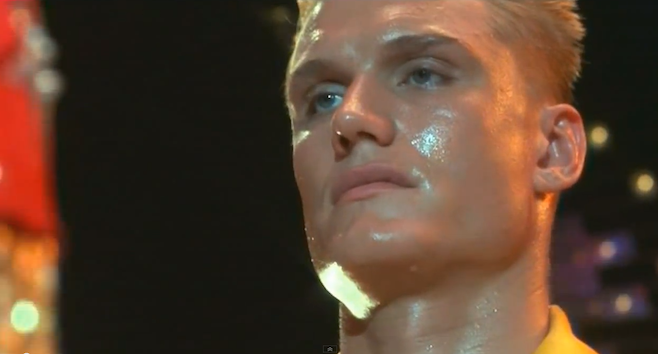
If you consider the headlines of the last few weeks it’s with a certain sense of irony we begin with the character of Ivan Drago from the 4th instalment of the Rocky series of movies. The chemically assisted Soviet boxer, probably designed as a champion from the Moscow Olympics, may be a caricature of Communist era Russia but has remained a popular villain in the thirty years since the film was released. The script also makes it clear that Drago’s wife, Ludmilla, is herself an Olympic champion in the swimming pool. Incidentally the actor, who played Drago, Dolph Lundgren, had a genuine Olympic link – he was the section manager for the US modern pentathlon team in Atlanta in 1996.
Ivan Drago-Rocky-villain
Ivan Drago

The Rocky series may be nearly forty years old now but that’s nothing compared to the longevity of James Bond. In the 2002 film “Die Another Day” we are introduced to MI6 agent Miranda Frost, an Olympic champion from the Sydney Olympics, who is eventually revealed to be in the debt of the North Korean villain of the piece after he arranged that her opponent for gold “overdosed on steroids”. An earlier film in the series, “For Your Eyes Only”, featured an East German Olympic biathlete turned assassin.
Shooting seems a popular Olympic sport in cinematic terms with the Oscar nominated 2014 film “American Sniper” featuring, as a main antagonist, a Syrian Olympic champion marksman called Mustafa and, as strange as it seems, another fictional champion shooter threatened to cause a diplomatic incident for a time in 2005. The Bollywood film “Sarkar” features an Olympic medallist from Dubai who is hired as a contract killer. Unfortunately for the filmmakers the UAE’s only Olympic medal at the time had come from Sheikh Ahmed al-Maktoum, a member of Dubai’s ruling family, in trap shooting. An apology was sent to Sheikh Ahmed and the controversial scenes were edited.

1937 saw the release of “Charlie Chan at the Olympics”, which blended real footage from the Berlin Games into a murder mystery. After the eponymous hero solves the crime he finds time to watch his son win an Olympic swimming title.

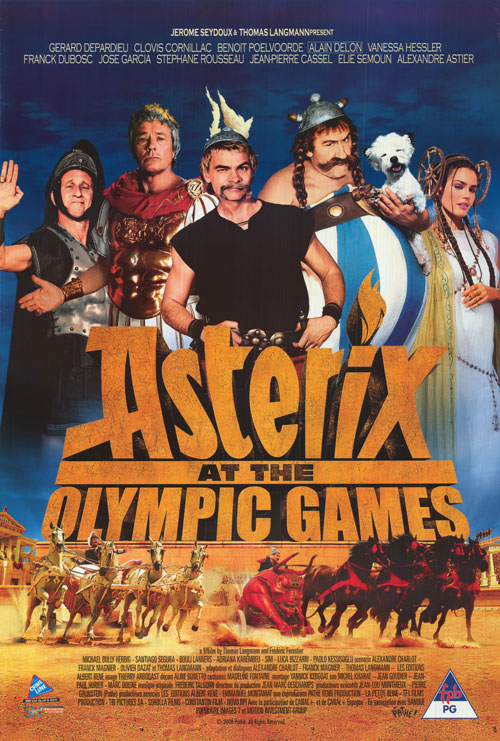
Even the ancient Olympic Games has been referenced on celluloid in cartoon form through the shape of “Asterix at the Olympic Games” where the eponymous Gaulish hero wins an Olympic title when every one of his opponents succumb to the temptation of magic potion and is disqualified.
MPW-55434

One of the best movies to be based around the subject was “Downhill Racer”, a 1969 vehicle for the then box-office sensation Robert Redford, which centred on a brash American making his way on the European skiing circuit and towards an Olympic title. The acclaimed critic Roger Ebert said at the time it was “the best movie ever made about sports—without really being about sports at all.”
The following year film producer and self-confessed Olympic fan Richard F. Zanuck produced “The Games”, a movie based on four runners of vastly differing backgrounds who competed for glory in the marathon at a fictional Rome Olympics. Filmmakers have long seen athletics as a rich seam to mine for Olympic movies as was seen in the 1955 film Geordie, about a Scottish Hammer thrower and Golden Girl from 1979 which centred on the premise of a neo-Nazi scientist adopting an American orphan with the single purpose of turning her into an Olympic pentathlon champion.

Other sports that have flourished on the silver screen include figure skating in the guise of romantic comedy “The Cutting Edge”. The story of a spoilt American skater teaming up with a former ice hockey player on and off the ice was successful enough to spawn three sequels. The dubious acting talents of Dolph Lundgren once again feature in “Pentathlon”, probably the only thriller based around the Olympic modern pentathlon. Lundgen plays an East German champion whose comeback for the 1988 Olympic Games is threatened by his former coach turned neo-Nazi terrorist. It was badly received at the time and is generally considered the worst movie on this list. 1997’s “Murder at 1600”, with Diane Lane as a US Secret Service agent who was also an Olympic shooting champion, was another that was panned by the critics.

Moving our attention towards television, and also to the distant future, we can point out that 1960s kids TV puppet show Thunderbirds. The show, which was hugely popular in the UK and Australia, featured a character called Gordon Tracy who was / will be an Olympic swimming champion at the butterfly stroke around the year 2060. Much later US animated comedy series “Futurama” introduced the limbo into the 30th century incarnation of the Olympics and set one of the main characters, Jamaican bureaucrat Hermes Conrad, on a quest for the championship against his arch rival Barbados Slim.

In literature the classic children’s book “Matilda” by Roald Dahl featured the fearsome Miss Trunchbull who was described as an Olympic javelin, discus and hammer thrower from the 1972 Olympics. It is unknown if she was successful in her efforts in Munich. The introduction of a “throwing the girl by her pigtails” event might have ensured victory.
Another favourite of children was the runner Alf Tupper, the “Tough of the Track”, whose appearances in British comics lasted from 1949 to 1992. His longevity as a middle distance runner is marked by his wins at both the Helsinki and Barcelona Olympics.

The theatre has not provided much to add to this list with the exception of “Amigos”, a play by the award winning Australian playwright David Williamson. It concerns the relationships inside a medal winning rowing quartet thirty four years after they reach the podium at the 1968 Games.

Of course there may be more that we have missed, please feel free to remind us of any omissions.
Thanks to David Clark for suggesting this subject.

Everything You Wanted to Know About Olympic Athletics Appearances

So we did a recent post on Olympians who have made more than one appearance at the Olympics. One of the replies we got back was that it would be interesting to know more about this as it relates to the best known summer Olympic sport – athletics (track & field). So here we go.

Who has appeared in each event the most times? Seven athletes have competed in the same Olympic athletics event 6 times, with Merlene Ottey doing this in 3 events – the 100, 200, and 4×100 relay – for 9 occurrences in all. But we’ll go further and list who has appeared in each track & field event the most times below, requiring at least 4 appearances. The list for each event is as follows:

Kim Collins

[table]

###,Event,Name,NOC,Gdr,YR1,YR2,YR3,YR4,YR5,YR6

4,100 metres,Tom Robinson,BAH,M,1956,1960,1964,1968,,

4,,Hasely Crawford,TTO,M,1972,1976,1980,1984,,

4,,Ray Stewart,JAM,M,1984,1988,1992,1996,,

4,,Ato Boldon,TTO,M,1992,1996,2000,2004,,

4,,Kim Collins,SKN,M,1996,2000,2004,2008,,

5,200 metres,Pietro Mennea,ITA,M,1972,1976,1980,1984,1988,

4,,Don Quarrie,JAM,M,1972,1976,1980,1984,,

4,,Róbson da Silva,BRA,M,1984,1988,1992,1996,,

4,,Christian Malcolm,GBR,M,2000,2004,2008,2012,,

4,400 metres,Chris Brown,BAH,M,2000,2004,2008,2012,,

5,800 metres,Paul Martin,SUI,M,1920,1924,1928,1932,1936,

4,,José Luiz Barbosa,BRA,M,1984,1988,1992,1996,,

4,,Johnny Gray,USA,M,1984,1988,1992,1996,,

4,,Yury Borzakovsky,RUS,M,2000,2004,2008,2012,,

5,1500 metres,Branko Zorko,YUG,M,1988,1992,1996,2000,2004,

4,,Marcus O’Sullivan,IRL,M,1984,1988,1992,1996,,

4,5000 metres,Emiel Puttemans,BEL,M,1968,1972,1976,1980,,

4,,Craig Mottram,AUS,M,2000,2004,2008,2012,,

4,10000 metres,Domingo Tibaduiza,COL,M,1972,1976,1980,1984,,

4,,Haile Gebrselassie,ETH,M,1996,2000,2004,2008,,

5,Marathon,Toni Bernadó,AND,M,1996,2000,2004,2008,2012,

4,,8 tied with 4,,M,,,,,,

5,110 metres hurdles,Carlos Sala,ESP,M,1980,1984,1988,1992,1996,

4,,6 tied with 4,,M,,,,,,

4,400 metres hurdles,Luigi Facelli,ITA,M,1924,1928,1932,1936,,

4,,Samuel Matete,ZAM,M,1988,1992,1996,2000,,

4,,Félix Sánchez,DOM,M,2000,2004,2008,2012,,

4,,Periklis Iakovakis,GRE,M,2000,2004,2008,2012,,

4,,Angelo Taylor,USA,M,2000,2004,2008,2012,,

4,Steeplechase,Cahit Önel,TUR,M,1948,1952,1960,1964,,

5,20 kilometres Walk,Vladimir Golubnichy,URS,M,1960,1964,1968,1972,1976,

5,,Jeffersón Pérez,ECU,M,1992,1996,2000,2004,2008,

4,4 x 100 metres relay,Jocelyn Delecour,FRA,M,1956,1960,1964,1968,,

4,,Nobuharu Asahara,JPN,M,1996,2000,2004,2008,,

4,,Marc Burns,TTO,M,2000,2004,2008,2012,,

4,4 x 400 metres relay,Chris Brown,BAH,M,2000,2004,2008,2012,,

6,50 kilometres Walk,Jesús Ángel García,ESP,M,1992,1996,2000,2004,2008,2012

5,,John Ljunggren,SWE,M,1948,1952,1956,1960,1964,

5,,Abdon Pamich,ITA,M,1956,1960,1964,1968,1972,

5,,Tim Berrett,CAN,M,1992,1996,2000,2004,2008,

6,High Jump,Dragutin Topić,IOA,M,1992,1996,2000,2004,2008,2012

4,,Kuniyoshi Sugioka,JPN,M,1960,1964,1968,1972,,

4,Pole Vault,Javier García,ESP,M,1988,1992,1996,2000,,

4,,Tim Lobinger,GER,M,1996,2000,2004,2008,,

4,,Romain Mesnil,FRA,M,2000,2004,2008,2012,,

4,,Denys Yurchenko,UKR,M,2000,2004,2008,2012,,

5,Long Jump,Igor Ter-Ovanesyan,URS,M,1956,1960,1964,1968,1972,

4,,Carl Lewis,USA,M,1984,1988,1992,1996,,

4,,Iván Pedroso,CUB,M,1992,1996,2000,2004,,

4,Triple Jump,8 tied with 4,,M,,,,,,

4,Shot Put,9 tied with 4,,M,,,,,,

5,Discus Throw,Aleksander Tammert,EST,M,1996,2000,2004,2008,2012,

5,,Virgilijus Alekna,LTU,M,1996,2000,2004,2008,2012,

5,Hammer Throw,Alexandros Papadimitriou,GRE,M,1996,2000,2004,2008,2012,

5,,Szymon Ziółkowski,POL,M,1996,2000,2004,2008,2012,

5,Javelin Throw,Janusz Sidło,POL,M,1952,1956,1960,1964,1968,

5,,Urs von Wartburg,SUI,M,1960,1964,1968,1972,1976,

5,,Jan Železný,TCH,M,1988,1992,1996,2000,2004,

4,Decathlon,Georg Werthner,AUT,M,1976,1980,1984,1988,,

4,,Daley Thompson,GBR,M,1976,1980,1984,1988,,

4,,Erki Nool,EST,M,1992,1996,2000,2004,,

4,,Roman Šebrle,CZE,M,2000,2004,2008,2012,,

6,100 metres,Merlene Ottey,JAM,F,1984,1988,1992,1996,2000,2004

5,,Debbie Ferguson-McKenzie,BAH,F,1996,2000,2004,2008,2012,

6,200 metres,Merlene Ottey,JAM,F,1980,1984,1988,1992,1996,2004

5,,Mary Onyali-Omagbemi,NGR,F,1988,1992,1996,2000,2004,

4,400 metres,Sandie Richards,JAM,F,1988,1992,1996,2000,,

4,,Aliann Pompey,GUY,F,2000,2004,2008,2012,,

6,800 metres,Maria Mutola,MOZ,F,1988,1992,1996,2000,2004,2008

5,,Letitia Vriesde,SUR,F,1988,1992,1996,2000,2004,

4,1500 metres,Carla Sacramento,POR,F,1992,1996,2000,2004,,

4,,Natalia Rodríguez,ESP,F,2000,2004,2008,2012,,

4,3000/5000 metres,Roberta Brunet,ITA,F,1988,1992,1996,2000,,

4,,Sonia O’Sullivan,IRL,F,1992,1996,2000,2004,,

4,10000 metres,Derartu Tulu,ETH,F,1992,1996,2000,2004,,

5,Marathon,Lidia Şimon,ROU,F,1996,2000,2004,2008,2012,

4,,Lisa Martin-Ondieki,AUS,F,1984,1988,1992,1996,,

4,,Lorraine Moller,NZL,F,1984,1988,1992,1996,,

4,,Erika Olivera,CHI,F,1996,2000,2004,2012,,

5,80/100 metres hurdles,Gail Devers-Roberts,USA,F,1988,1992,1996,2000,2004,

4,,7 tied with 4,,F,,,,,,

4,20 kilometres Walk,María Vascó,ESP,F,2000,2004,2008,2012,,

4,,Olive Loughnane,IRL,F,2000,2004,2008,2012,,

4,,Kristina Saltanovič,LTU,F,2000,2004,2008,2012,,

6,4 x 100 metres relay,Merlene Ottey,JAM,F,1980,1984,1988,1992,1996,2000

4,,5 tied with 4,,F,,,,,,

5,4 x 400 metres relay,Sandie Richards,JAM,F,1988,1992,1996,2000,2004,

4,,Cathy Rattray-Williams,JAM,F,1980,1984,1988,1992,,

4,,Irina Khlyustova,BLR,F,2000,2004,2008,2012,,

5,High Jump,Amy Acuff,USA,F,1996,2000,2004,2008,2012,

4,,6 tied with 4,,F,,,,,,

4,Pole Vault,Monika Pyrek,POL,F,2000,2004,2008,2012,,

4,,Svetlana Feofanova,RUS,F,2000,2004,2008,2012,,

4,,Yelena Isinbayeva,RUS,F,2000,2004,2008,2012,,

5,Long Jump,Willye White,USA,F,1956,1960,1964,1968,1972,

5,,Fiona May,GBR,F,1988,1992,1996,2000,2004,

5,,Jackie Edwards,BAH,F,1992,1996,2000,2004,2008,

4,Triple Jump,Yamilé Aldama,CUB,F,2000,2004,2008,2012,,

4,,Tatyana Lebedeva,RUS,F,2000,2004,2008,2012,,

4,Shot Put,8 tied with 4,,F,,,,,,

6,Discus Throw,Lia Manoliu,ROU,F,1952,1956,1960,1964,1968,1972

6,,Nicoleta Grădinaru-Grasu,ROU,F,1992,1996,2000,2004,2008,2012

5,,Olga Fikotová-Connolly,TCH,F,1956,1960,1964,1968,1972,

5,,Ellina “Elya” Zvereva,URS,F,1988,1996,2000,2004,2008,

5,,Irina Yatchenko,EUN,F,1992,1996,2000,2004,2008,

4,Hammer Throw,Yipsi Moreno,CUB,F,2000,2004,2008,2012,,

6,Javelin Throw,Tessa Sanderson,GBR,F,1976,1980,1984,1988,1992,1996

5,,Trine Solberg-Hattestad,NOR,F,1984,1988,1992,1996,2000,

5,,Laverne Eve,BAH,F,1988,1996,2000,2004,2008,

5,Heptathlon/Pentathlon,Sabine Braun,FRG,F,1984,1988,1992,1996,2000,

4,,Jackie Joyner-Kersee,USA,F,1984,1988,1992,1996,,

4,,Irina Naumenko,KAZ,F,2000,2004,2008,2012,,

4,,Austra Skujytė,LTU,F,2000,2004,2008,2012,,

[/table]

Merlene Ottey

Now looking at the event-by-event appearance records, we note that 6 athletes (5 women, 1 man) competed at least 3 times in 3 events. They are as follows, with the Jamaican wonder woman Merlene Ottey having competed 6 times in 3 different events:

[table]

Name,Gdr,NOC,Event1,###1,Event2,###2,Event3,###3

Merlene Ottey,F,JAM,100,6,200,6,4×100,6

Pauline Davis-Thompson,F,BAH,100,3,200,4,4×100,3

Debbie Ferguson-McKenzie,F,BAH,100,5,200,4,4×100,3

Diego Ordóñez,M,ESP,100,3,200,3,4×100,3

Mary Onyali-Omagbemi,F,NGR,100,3,200,5,4×100,3

Shirley Strickland de la Hunty,F,AUS,100,3,4×100,3,80HH,3

[/table]

So who has competed in the most Olympic track & field athletics events? This gets a little complicated. Prior to 1928 there were a number of events no longer on the Olympic Program – standing jumps, odd walk distances, both hands throws, freestyle javelin, cross-country, various team races, and so on. In addition, we count the 1906 Olympic Games, which the IOC does not (they should). Here is the list of who has competed in the most athletics events, counting all events on the Program. The column on the left does not include 1906, while the second column in includes 1906, which brings in Martin Sheridan, who would be #3 if 1906 is included (I am required to mention Sheridan by my Chocolate Lab, Marty, whose full name is Martin Sheridan Mallon).

As you can see, and will see even further, Merlene Ottey and Eric Lemming are the queen and king of track & field appearances. Ottey leads this list, but Lemming would be #1 if we count 1906, at which Games he started in 8 events.

[table]

Events,w1906,Name,Gdr,NOC

19,19,Merlene Ottey,F,JAM

14,22,Eric Lemming,M,SWE

12,12,Debbie Ferguson-McKenzie,F,BAH

12,12,Mary Onyali-Omagbemi,F,NGR

12,12,Elmer Niklander,M,FIN

12,12,Géo André,M,FRA

12,12,Paavo Nurmi,M,FIN

11,11,Pietro Mennea,M,ITA

11,11,Pauline Davis-Thompson,F,BAH

11,11,Irena Szewińska-Kirszenstein,F,POL

11,11,Lawson Robertson,M,USA

11,11,Verner Järvinen,M,FIN

11,11,Gustav Krojer,M,AUT

8,15,Martin Sheridan,M,USA

[/table]

So the question that started this was how many Olympians compete in more than 1 Olympics? The blog reader wanted to know many track & field Olympians compete in more than 1 event? Here is that table, and here we do include 1906 and all events.

[table]

#Events,###,%%%

22 Events,1,0.0%

19 Events,1,0.0%

15 Events,1,0.0%

12 Events,5,0.0%

11 Events,6,0.0%

10 Events,12,0.1%

9 Events,24,0.1%

8 Events,25,0.1%

7 Events,68,0.3%

6 Events,188,0.9%

5 Events,385,1.9%

4 Events,826,4.0%

3 Events,2030,9.8%

2 Events,5429,26.3%

1 Event,11623,56.4%

[/table]

Its evident that most athletics Olympians compete in only a single event, and over 92% compete in 3 or fewer events.

Now Merlene Ottey competed in 19 events but she competed in a lot of relays, 7 in all. What happens if we only look at athletics Olympians competing in individual events? Again we have 2 columns, one not including 1906, and the second column including 1906, which adds Sheridan (sorry, its required), Ray Ewry, Meyer Prinstein, and Lawson Robertson. Note that Lemming’s figures do not change – he competed only in individual events.

Eric Lemming

[table]

IndEvts,w1906,Name,Gdr,noc

14,22,Eric Lemming,M,SWE

12,12,Elmer Niklander,M,FIN

12,12,Merlene Ottey,F,SLO

11,11,Verner Järvinen,M,FIN

11,11,Géo André,M,FRA

9,9,Debbie Ferguson-McKenzie,F,BAH

9,9,Paavo Nurmi,M,FIN

9,9,Miklós Kovács,M,HUN

9,9,Irena Szewińska-Kirszenstein,F,POL

9,9,Platt Adams,M,USA

9,9,Ralph Rose,M,USA

8,15,Martin Sheridan,M,USA

8,10,Ray Ewry,M,USA

7,10,Meyer Prinstein,M,USA

6,11,Lawson Robertson,M,USA

[/table]

And here is the breakdown of track & field Olympians by number of individual events in which they have competed – again including 1906 and all events.

[table]

#Evts,###,%%%

22 Events,1,0.0%

15 Events,1,0.0%

12 Events,2,0.0%

11 Events,3,0.0%

10 Events,4,0.0%

9 Events,11,0.1%

8 Events,12,0.1%

7 Events,32,0.2%

6 Events,73,0.4%

5 Events,203,1.1%

4 Events,565,2.9%

3 Events,1568,8.1%

2 Events,4754,24.7

1 Event,12044,62.5%

[/table]

As you can see, when looking only at individual events, by far most athletes compete in only a single Olympic track & field event.

So who has competed in the most track & field events at a single Olympics? Once again, we have the problem of the many older, unusual events, we have the problem of 1906, and we have the problem of individual or team events. Here is the list of the most events at a single Olympics, counting only modern events, and counting only individual events. And again Eric Lemming tops the list. This includes all those competing in 4 or more individual events at a single Olympics, and only 3 of them are women.

[table]

###,Name,Gdr,NOC,Year,Evt1,Evt2,Evt3,Evt4,Evt5,Evt6

6,Eric Lemming,M,SWE,1900,HJ,PV,LJ,TJ,DT,HT

5,Fritz Hofmann,M,GER,1896,100,400,HJ,TJ,SP,

5,Oscar Guttormsen,M,NOR,1908,100,200,400,110HH,TJ,

5,Johannes Viljoen,M,RSA,1928,100,110HH,LJ,TJ,Deca,

4,Alphonse Grisel,M,FRA,1896,100,400,LJ,DT,,

4,Henrik Sjöberg,M,SWE,1896,100,HJ,LJ,DT,,

4,Bob Garrett,M,USA,1896,HJ,LJ,SP,DT,,

4,Meyer Prinstein,M,USA,1904,100,400,LJ,TJ,,

4,Vincent Duncker,M,GER,1906,100,400,800,110HH,,

4,Aage Petersen,M,DEN,1906,100,400,HJ,LJ,,

4,Karl Lampelmayer,M,AUT,1906,100,400,LJ,TJ,,

4,Gustav Krojer,M,AUT,1906,100,HJ,LJ,TJ,,

4,Jacobus Hoogveld,M,NED,1908,100,200,400,LJ,,

4,Hugo Wieslander,M,SWE,1908,LJ,SP,DT,JT,,

4,Henry Leeke,M,GBR,1908,SP,DT,HT,JT,,

4,Bram Evers,M,NED,1908,400,800,PV,LJ,,

4,Alfredo Pagani,M,ITA,1912,110HH,HJ,LJ,Deca,,

4,Skotte Jacobsson,M,SWE,1912,100,200,TJ,Deca,,

4,Paul Hammer,M,LUX,1924,100,200,400,LJ,,

4,Valter Ever,M,EST,1924,HJ,PV,LJ,Deca,,

4,Gretel Bolliger,F,SUI,1952,80HH,LJ,SP,DT,,

4,Eduardo Fontecilla,M,CHI,1956,800,1500,Mara,Steeple,,

4,Marijana Lubej,F,YUG,1968,100,200,80HH,Pent,,

4,Eugenia Osho-Williams,F,SLE,1980,100,200,400,800,,

3,227 tied with 3,,,,,,,,,

[/table]

Here is the list if we include all track & field events that have ever been on the Olympic Program. A familiar face leads the list, but you will note that the top 4, who competed in 8 and 7 events, all did so in 1906. Sheridan actually entered 15 events in 1906, but got injured in the pentathlon and withdrew from a number of them.

Martin Sheridan

[table]

###,name,Gdr,NOC,Year,Evt1,Evt2,Evt3,Evt4,Evt5,Evt6,Evt7,Evt8

8,Eric Lemming,M,SWE,1906,TJ,SP,DT,sLJ,DTg,JTf,StoneThr,Pent

7,Gustav Krojer,M,AUT,1906,100,HJ,LJ,TJ,sHJ,sLJ,Pent,

7,Julius Wagner,M,GER,1906,100,LJ,SP,sLJ,DTg,StoneThr,Pent,

7,Martin Sheridan,M,USA,1906,SP,DT,sHJ,sLJ,DTg,StoneThr,Pent,

6,Bram Evers,M,NED,1908,400,800,PV,LJ,sLJ,1600relay,,

6,Jacobus Hoogveld,M,NED,1908,100,200,400,LJ,sLJ,1600relay,,

6,Ville Ritola,M,FIN,1924,5000,10000,Steeple,3KTm,XC,XCTm,,

6,Einar Nilsson,M,SWE,1912,SP,DT,Dec,Pent,SPb,DTb,,

6,Martin Sheridan,M,USA,1908,TJ,SP,DT,sHJ,sLJ,DTg,,

6,Eric Lemming,M,SWE,1900,HJ,PV,LJ,TJ,DT,HT,,

6,Henry Leeke,M,GBR,1908,SP,DT,HT,JT,DTg,JTf,,

6,Paul Weinstein,M,GER,1906,HJ,LJ,TJ,sHJ,sLJ,JTf,,

6,Pierre Failliot,M,FRA,1912,100,200,4×100,4×400,Dec,Pent,,

6,István Mudin,M,HUN,1906,SP,DT,sLJ,DTg,JTf,Pent,,

6,Heikki Åhlman,M,FIN,1906,PV,SP,DT,JTf,StoneThr,Pent,,

6,Géo André,M,FRA,1912,110HH,HJ,Dec,Pent,sHJ,sLJ,,

5,39 tied with 5,,,,,,,,,,,

4,139 tied with 4,,,,,,,,,,,

[/table]

So this is probably the list you’re looking for – most events at a single Olympics, counting only modern events, but including individual events and relays. Lemming is at the top with 6 in 1900, with 8 men who competed in 5 events in various years (none 1906), and Marion Jones in 2000 was the only woman to ever compete in 5 track & field events at a single Olympics. Or did she really compete? Maybe she has been erased – see the movie “Eraser” with Arnold Schwarzenegger, Vanessa Williams, and James Caan.

[table]

###,Name,Gdr,NOC,Year,Evt1,Evt2,Evt3,Evt4,Evt5,Evt6

6,Eric Lemming,M,SWE,1900,High Jump,PV,LJ,TJ,DT,HT

5,Fritz Hofmann,M,GER,1896,100 metres,400,HJ,TJ,SP,

5,Oscar Guttormsen,M,NOR,1908,100 metres,200,400,110HH,TJ,

5,Charles Lelong,M,FRA,1912,100 metres,200,400,4×100,4×400,

5,Max Herrmann,M,GER,1912,100 metres,200,400,4×100,4×400,

5,Pierre Failliot,M,FRA,1912,100 metres,200,4×100,4×400,Deca,

5,Johannes Viljoen,M,RSA,1928,100 metres,110HH,LJ,TJ,Deca,

5,Abebe Hailou,M,ETH,1956,100 metres,200,400,4×100,4×400,

5,Beyene Legesse,M,ETH,1956,100 metres,200,400,4×100,4×400,

5,Marion Jones,F,USA,2000,100 metres,200,4×100,4×400,LJ,

4,74 tied with 4,,,,,,,,,

3,883 tied with 3,,,,,,,,,

[/table]

Now a number of Olympians have competed in 2 or more track & field events at 2 or more Olympics. But only 8 Olympians have competed in 3 or more track & field events at 3 or more Olympics, with 2 of them dropping off the list if you are a 1906 stickler. There are 4 men and 4 women, with Merlene Ottey having done this a remarkable 5 times. Eric Lemming is also on this list, but that includes 1906.

[table]

3+Oly,Name,Gdr,NOC,YR1,YR2,YR3,YR4,YR5

5,Merlene Ottey,F,JAM,1980,1984,1988,1992,1996

3,Raelene Boyle,F,AUS,1972,1968,1976,,

3,Shirley Strickland de la Hunty,F,AUS,1948,1952,1956,,

3,Phil Edwards,M,CAN,1928,1932,1936,,

3,Diego Ordóñez,M,ESP,1920,1924,1928,,

3,Mary Onyali-Omagbemi,F,NGR,1992,1996,2000,,

3,Eric Lemming,M,SWE,1900,1906,1908,,

3,Jim Lightbody,M,USA,1904,1906,1908,,

[/table]

Now yesterday Galen Rupp qualified for the 2016 US Olympic marathon team, and is talking of also running the 10,000 in Rio. Remember 1952, when Emil Zátopek won the 5,000, 10,000, and marathon? (I don’t remember it too well – I was 5-months-old) Has that ever been done before or since? In London the doyen of Olympic beat writers Phil Hersh asked me to dig up some data about how common is it now for athletes to compete in multiple related events, such as the Zátopek triple. So we looked at a few of those.

As anyone ever competed in the 100, 200, and 400 at a single Olympics. Yes, in fact, it has been done 36 times, by 32 men and 4 women. You never heard of any of them. The last to do it were females Zoila Stewart (CRC) and Ngozi Mwanamwambwa (ZAM) in 1992. The last man to do it was Daniel André, a Mauritian, in 1984.

What about running the 200, 400, and 800? This is much rarer and has only been done 4 times, by 3 men, the last of whom did it in 1924. Again, you don’t know any of the men. The woman was Eugenia Osho-Williams of Sierra Leone who in 1980 achieved the remarkable feat of running the 100, 200, 400, and 800, figuring on both these first two lists, and is the only one to do this quadruple. She did not get past the first round of any event.

What about the 400, 800, 1500 triple? Been done 7 times, 6 from 1904-12, with Israeli Mark Handelsman doing this in 1980.

Nobody has ever run the 800, 1500, and 5K at one Olympics. But in the 1500, 5K, and 10K triple, we have 5 names, 2 of whom you should know. Sweden’s Edwin Wide did this in 1924, and Kenyan Kip Keino did it in 1968. The last time it happened was in 1968, when Keino was joined by Nepali Hari Bahadur Rokaya – some of these are pretty obscure.

How about the Zátopek triple of 5K, 10K, and marathon? This has been done 17 times, and there are some pretty famous names in this group. Besides Zátopek, Lasse Virtanen (FIN) did it in 1932, and his countryman, Lasse Virén, did it in 1976, winning the 5 and 10, and placing sixth in the marathon. Ron Clarke ran all 3 events in 1964, and in 1968, Ethiopian Mamo Wolde and Kenyan Naftali Temu ran all 3 long-distance events, with Wolde winning gold in the marathon, and silver in the 10K, which was won by Temu, who also won a bronze in the 5K.

Running both hurdles races – the 110 (or 100) and 400 hurdles – has been done only 4 times. It happened in 1928 and 1932, and the last 2 times it occurred was in 1964.

In 1936 Jesse Owens won the 100, 200 and long jump, as did Carl Lewis in 1984. How often have people even competed in this sprinting-oriented triple? It has happened 21 times, with Lewis doing it in 1984 and 1988, and he was the last man. Several famous women did this – Irena Szewińska-Kirszenstein (POL) did it in 1968, Heide Drechsler-Daute (GDR) did it in 1988, and Marion Jones (USA) did it in 2000, unless she has been erased.

At London in 2012 American Will Claye competed in the long jump and triple jump, as did Australian Henry Frayne. This is pretty common as this made 142 times this has been achieved at a single Olympics.

Let’s not forget the big guys and gals, the weight throwers. Shot put and discus throw is a common double for the throwers to pull off. In fact, its been done 185 times at the Olympics, most notably by Soviet Tamara Press, who won both events in 1968, and in 1964 won the shot put and won silver in the discus. In 1906, Martin Sheridan also won both events – there, I got him in again.

Have any throwers ever competed in more than 2 events? Of course they have – why else would I bring it up? Between 1900-24, 13 throwers competed 14 times in 3 or more of the weight throwing events (shot, discus, hammer, javelin). American Ralph Rose did it in 1904 and 1912, competing in the shot, discus, and hammer each time, winning a complete set of medals in all three events in 1904 – gold in shot put, silver in discus throw, and bronze in hammer throw. Perhaps most remarkably, in 1908 Britian Henry Leeke competed in all four throwing events, the only time this has been done at the Olympics.

So this should answer pretty much any question you had about who has competed in the most track & field athletics events.

With thanx to my research associates, Martin Sheridan Mallon (the lab) and Barney Rubble Mallon (the Westie)

MartyBarney


Olympic Marathon Age Records

The US Olympic marathon trials were held today and Meb Keflezighi made his fourth Olympic team. Meb won a bronze medal in the 2004 Olympic marathon and will be 41 years old on the day of the 2016 Olympic marathon. Much is being made about his age – how does it stack up against previous Olympic marathoners?

Meb Keflezighi

On the day of the Olympic marathon in Rio, Meb will be 41 years, 108 days old (41-108). That’s relatively ancient for a world-class marathoner, but far from unheard of. In fact, there have been 21 Olympic men run the Olympic marathon at an older age, led by Canadian Percy Wyer, who ran the 1936 marathon when he was 52-years-old. Here is the top 25 through 2012:

[table]

Age,name,year,noc

52-199,Percy Wyer,1936,CAN

48-196,Bohumil “Boris” Honzátko,1924,TCH

46-135,Haile Satayin,2008,ISR

45-246,Toni Bernadó,2012,AND

44-195,Percy Wyer,1928,CAN

44-069,Jack Foster,1976,NZL

44-017,Wally Hayward,1952,RSA

43-023,Luis López,1992,CRC

42-240,Ion Pool,1900,GBR

42-194,Roman Kejžar,2008,SLO

42-140,Haile Satayin,2004,ISR

41-345,Wallace Williams,1988,ISV

41-258,Toni Bernadó,2008,AND

41-235,Panagiotis “Peter” Trivoulidis,1920,GRE

41-235,Eusebio Guiñez,1948,ARG

41-206,Ville Kyrönen,1932,FIN

41-206,Andrés Espinosa,2004,MEX

41-204,Harold Webster,1936,CAN

41-201,William Saward,1900,GBR

41-166,Baba Ibrahim Suma-Keita,1988,SLE

41-148,Jack Holden,1948,GBR

40-352,Cristea Dinu,1952,ROU

40-336,Johnny A. Kelley,1948,USA

40-309,Mikko Hietanen,1952,FIN

40-185,Franjo Mihalić,1960,YUG

[/table]

What about among US men Olympic marathoners, you surely are asking? Meb will become the oldest American man to run the marathon at the Olympics, with the current oldest being Johnny “The Elder” Kelley at London in 1948. Meb’s 2012 London marathon already put him 6th oldest among US men. Here is the US top 10 list:

[table]

Age,name,year,noc

40-336,Johnny A. Kelley,1948,USA

40-104,Jimmy Henigan,1932,USA

40-059,Clarence DeMar,1928,USA

38-321,Billy Churchill,1924,USA

38-235,Albert “Whitey” Michelsen,1932,USA

37-099,Meb Keflezighi,2012,USA

36-102,Jimmy Henigan,1928,USA

36-036,Clarence DeMar,1924,USA

35-241,Tom Jones,1952,USA

35-223,Abdi Abdirahman,2012,USA

[/table]

This will be Meb’s third Olympic marathon, after 2004 and 2012 – he ran the 10,000 metres in 2000. Have any marathoners ever competed in more Olympic races? Yes, in fact, Andorran Toni Bernadó and Romanian Lidia Şimon ran 5 Olympic marathons from 1996-2012. Here is the list of all those running 4 or more Olympic marathons:

[table]

###,name,gender,noc,Yr1,Yr2,Yr3,Yr4,Yr5

5,Toni Bernadó,M,AND,1996,2000,2004,2008,2012

5,Lidia Şimon,F,ROU,1996,2000,2004,2008,2012

4,Karel Lismont,M,BEL,1972,1976,1980,1984

4,Baikuntha Manandhar,M,NEP,1976,1980,1984,1988

4,Rob de Castella,M,AUS,1980,1984,1988,1992

4,Ahmed Salah,M,DJI,1984,1988,1992,1996

4,Lisa Martin-Ondieki,F,AUS,1984,1988,1992,1996

4,Lorraine Moller,F,NZL,1984,1988,1992,1996

4,Steve Moneghetti,M,AUS,1988,1992,1996,2000

4,Erika Olivera,F,CHI,1996,2000,2004,2012

4,Lee Bong-Ju,M,KOR,1996,2000,2004,2008

4,Pavel Loskutov,M,EST,1996,2000,2004,2008

4,Viktor Röthlin,M,SUI,2000,2004,2008,2012

[/table]

Shalane Flanagan will also run in her 4th Olympics, after racing the 5K in 2004, the 5 and 10K in 2008, and the marathon in 2012. Flanagan will be 35 years old in Rio. How does that stack up against female Olympic marathoners in terms of senescence? Here are the lists for the top 25 oldest women to run the Olympic marathon and the USA top 10 list:

[table]

Age,name,year,noc

48-234,Lourdes Klitzkie,1988,GUM

46-284,Joyce Smith,1984,GBR

46-236,Evy Palm,1988,SWE

43-083,Irina Bogacheva,2004,KGZ

42-195,Sue Hobson,2000,AUS

42-194,Constantina Tomescu,2012,ROU

41-141,María Luisa Muñoz,2000,ESP

41-058,Lorraine Moller,1996,NZL

40-298,Garifa Kuku,2000,KAZ

40-297,Ivana Sekyrová,2012,CZE

40-130,Colleen de Reuck,2004,USA

39-347,Irina Mikitenko,2012,GER

39-299,María Elena Espeso,2012,ESP

39-256,Priscilla Welch,1984,GBR

39-251,Francie Larrieu-Smith,1992,USA

39-159,Pauline Curley,2008,IRL

39-157,Rhonda Davidson-Alley,2000,GUM

39-116,Irina Bogacheva,2000,KGZ

39-077,Gaby Andersen-Schiess,1984,SUI

39-052,Liza Hunter-Galvan,2008,NZL

38-357,Mara Yamauchi,2012,GBR

38-335,Lidia Şimon,2012,ROU

38-251,Magda Ilands,1988,BEL

38-232,Nelly Chávez,1984,BOL

38-206,Constantina Tomescu,2008,ROU

[/table]

[table]

Age,name,year,noc

40-130,Colleen de Reuck,2004,USA

39-251,Francie Larrieu-Smith,1992,USA

37-349,Chris Clark,2000,USA

35-183,Deena Drossin-Kastor,2008,USA

35-082,Linda Somers,1996,USA

35-015,Magda Lewy-Boulet,2008,USA

34-091,Nancy Ditz,1988,USA

34-027,Kara Goucher,2012,USA

33-024,Blake Russell,2008,USA

33-009,Jenny Spangler,1996,USA

[/table]

Colleen de Reuck

Flanagan’s 2012 Olympic marathon was done at age 31-028, putting her 13th on the US list for oldest female Olympic marathoners through 2012. She will be 35-037 on the day of the women’s Rio marathon and will move up to 6th among US Olympic marathoners, but she will not crack the top 25 for all nations.


Competing in Multiple Olympics

So we’ve had a few e-mails recently concerning how common it is for athletes to compete in more than one Olympic Games. On the “Mike and Mike” ESPN radio show they speculated that it was actually quite rare for Olympians to compete in more than one Olympics. Thus we decided to look at this in some detail.

Its not actually that rare and further, its becoming more and more common for athletes to compete in 2 or more Olympics. That is especially true of the Winter Olympics. We will only examine the Games since World War II, since the 12-year gap between 1936 and 1948 will skew all results, and this brings us closer to the modern era.

Here are the overall tables for both men and women Olympians at the Summer and Winter Olympics:

[table]

Summer,Total,1G,2G,3G,4G,5G,6+G,1G,2+G

Totals,107696,80048,20001,5731,1449,348,119,74.3%,25.7%

Men,82256,62010,14625,4201,1071,263,86,75.4%,24.6%

Women,25440,18038,5376,1530,378,85,33,70.9%,29.1%

[/table]

[table]

Winter,Total,1G,2G,3G,4G,5G,6+G,1G,2+G

Totals,17459,11510,4059,1384,394,92,20,65.9%,34.1%

Men,12902,8607,2987,948,276,68,16,66.7%,33.3%

Women,4557,2903,1072,436,118,24,4,63.7%,36.3%

[/table]

So its fairly common to compete in more than one Olympics, although overall only about 30% of Olympians get to a second Games. You’ll note, however, that Winter Olympians do it more frequently than summer Olympians – 34.1% to 25.7%. And women seem to come back to a second Olympics slightly more often than do men.

Here are the lists of the Games since 1948, comparing athletes who started at each Olympics, and competed in either 1 or 2 or more (2+) Olympics. We stopped at 2008 and 2010, since anyone who first competed in 2012 or 2014 could only have competed at one Olympics as of February 2016.

[table]

Year,1Games,2+Games,Season

1948,73.8%,26.2%,S

1952,79.9%,20.1%,S

1956,70.5%,29.5%,S

1960,73.8%,26.2%,S

1964,73.7%,26.3%,S

1968,69.4%,30.6%,S

1972,75.1%,24.9%,S

1976,76.1%,23.9%,S

1980,79.6%,20.4%,S

1984,71.3%,28.7%,S

1988,67.7%,32.3%,S

1992,66.6%,33.4%,S

1996,64.8%,35.2%,S

2000,64.2%,35.8%,S

2004,61.9%,38.1%,S

2008,67.2%,32.8%,S

[/table]

[table]

Year,1Games,2+Games,Season

1948,74.6%,25.4%,W

1952,71.4%,28.6%,W

1956,72.1%,27.9%,W

1960,61.5%,38.5%,W

1964,66.5%,33.5%,W

1968,68.7%,31.3%,W

1972,64.9%,35.1%,W

1976,67.0%,33.0%,W

1980,65.5%,34.5%,W

1984,61.4%,38.6%,W

1988,61.1%,38.9%,W

1992,49.4%,50.6%,W

1994,56.8%,43.2%,W

1998,52.0%,48.0%,W

2002,51.6%,48.4%,W

2006,54.5%,45.5%,W

2010,53.8%,46.2%,W

[/table]

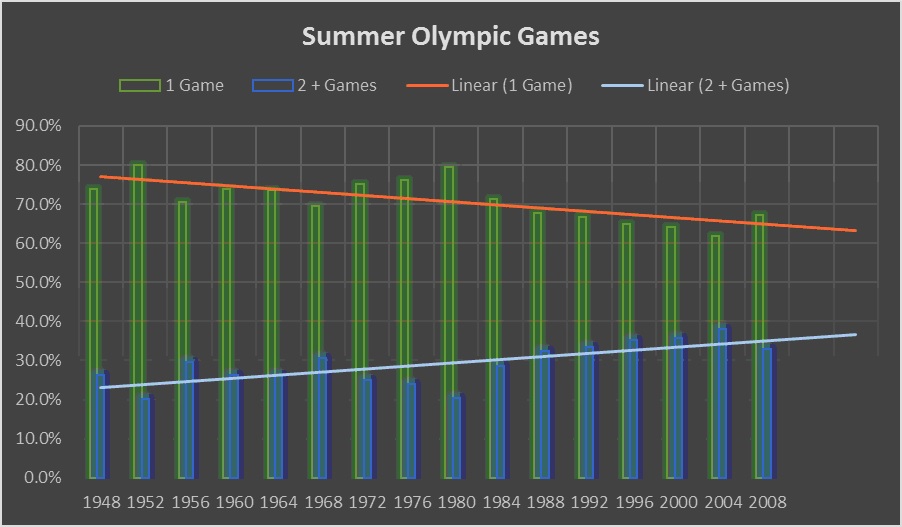
It is likely that the 2008 and 2010 numbers will eventually end up with a higher percentage for the 2+ Olympians, as some of those competing in 2008 and 2010 will likely compete in 2016 and 2018. The numbers seem to be increasing and if we look at a graph and determine a best fit for the numbers, its fairly obvious that more and more athletes are competing in 2 or more Olympics.

SummerMultiOlympians

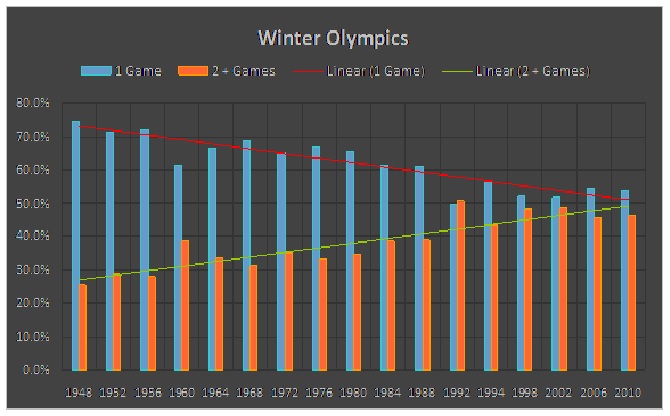
And here is the graph for the Winter Olympics, where there is now almost equilibrium between 1-time Olympians and those competing in 2 or more Games.

WinterMultiOlympians

The biggest spike for the Winter Games occurs between 1992 and 1994, when the Winter Olympics had their only gap of 2 years between Games.

Now which sports are particularly suited to Olympians competed more than one time? This is as you would expect, with equestrian, fencing, and shooting figuring prominently. But there are a few surprises, and this time we will look at how often Olympians compete 4 or more times, and 6 or more times. Here is the list by sports for the Summer Games – this include all Olympics since 1896:

[table]

Sport,1Games,2+Games,4+Games,6+Games

Archery,76.0%,24.0%,2.4%,0.3%

Athletics (Track & Field),72.3%,27.7%,1.6%,0.0%

Badminton,65.1%,34.9%,1.7%,0.0%

Baseball,85.7%,14.3%,0.3%,0.0%

Basketball,75.9%,24.1%,1.2%,0.0%

Beach Volleyball,65.7%,34.3%,1.6%,0.0%

Boxing,87.6%,12.4%,0.1%,0.0%

Canoe & Kayaking,66.9%,33.1%,3.2%,0.1%

Cycling,79.2%,20.8%,1.2%,0.1%

Diving,66.0%,34.0%,2.4%,0.0%

Equestrianism,70.4%,29.6%,4.3%,1.1%

Fencing,64.6%,35.4%,4.0%,0.2%

Football (Soccer),92.5%,7.5%,0.2%,0.0%

Golf,99.0%,1.0%,0.0%,0.0%

Gymnastics (Artistic),79.4%,20.6%,0.4%,0.0%

Handball,73.8%,26.2%,1.3%,0.0%

Hockey (Field),69.5%,30.5%,1.3%,0.0%

Judo,72.0%,28.0%,1.5%,0.0%

Modern Pentathlon,74.2%,25.8%,1.3%,0.0%

Rhythmic Gymnastics,87.4%,12.6%,0.2%,0.0%

Rowing & Sculling,76.5%,23.5%,1.4%,0.1%

Rugby Football,95.5%,4.5%,0.0%,0.0%

Sailing (Yachting),73.3%,26.7%,3.5%,0.3%

Shooting,68.9%,31.1%,5.0%,0.7%

Softball,76.0%,24.0%,1.1%,0.0%

Swimming,73.2%,26.8%,1.1%,0.0%

Synchronized Swimming,74.5%,25.5%,0.4%,0.0%

Table Tennis,57.4%,42.6%,7.5%,0.8%

Taekwondo,77.5%,22.5%,0.8%,0.0%

Tennis,69.1%,30.9%,1.7%,0.1%

Trampoline,53.4%,46.6%,4.1%,0.0%

Triathlon,66.3%,33.7%,1.0%,0.0%

Volleyball (Indoor),72.7%,27.3%,1.6%,0.0%

Water Polo,67.0%,33.0%,2.8%,0.0%

Weightlifting,72.7%,27.3%,1.4%,0.0%

Wrestling,72.4%,27.6%,1.4%,0.0%

[/table]

What’s up with table tennis, where over 43% of the Olympians compete more than once? Further, fully 7.5% of Olympic table tennis players have competed in 4 or more Olympics, the highest total for any sport, and that approaches twice as much as equestrian (4.3%) and fencing (4.0%), the two next highest sports for that stat. Looking at Olympians competed in 6 or more Games, only equestrian and table tennis have any significant proportion of their Olympians achieving that, with equestrian leading table tennis – 1.1% to 0.8% – of Olympic table tennis players competing in at least 6 Olympics.

Here is the similar list for the Winter Olympians, looking only at 2+ and 4+ Olympians:

[table]

Sport,1Games,2+Games,4+Games

Alpine Skiing,66.0%,34.0%,2.7%

Biathlon,57.6%,42.4%,5.2%

Bobsledding,73.7%,26.3%,2.7%

Cross-Country Skiing,64.7%,35.3%,4.0%

Curling,76.9%,23.1%,0.0%

Figure Skating,71.1%,28.9%,0.9%

Freestyle Skiing,64.0%,36.0%,4.3%

Ice Hockey,70.9%,29.1%,1.6%

Luge,57.2%,42.8%,6.1%

Nordic Combined,67.4%,32.6%,1.9%

Short-Track Speedskating,60.9%,39.1%,2.1%

Skeleton,74.8%,25.2%,0.0%

Ski Jumping,65.8%,34.2%,2.6%

Snowboarding,64.4%,35.6%,0.7%

Speed Skating,59.0%,41.0%,3.8%

[/table]

Not too surprising is that luge sliders compete in more than one Winter Olympics more frequently than other Winter sport Olympians. But it is surprising that biathletes do so almost as frequently as lugers, and biathlon is a very physically rigorous sport. We really can’t explain that.

So if you want to compete in more than one Olympics, pick your sport carefully, and realize you have a much better chance of doing this than your parents or grandparents did.

Olympic Birthday Medalists

Many people celebrate their birthday. What better way to celebrate it than to win an Olympic medal on one’s birthday? Has this actually happened at the Olympics? Yes, in fact, 86 athletes have done it 90 times.

Only one athlete has won 3 Olympic medals on his/her birthday and that was French archer Eugène Richez, who won 2 silvers and a bronze in team target archery events at the 1900 Olympics. Those Olympics were so unusual, and the archery events were especially so, let’s look at the 2 athletes who have won 2 medals on their birthday.

The first was Sidney Merlin, a British shooter who won a gold and bronze medal in 2 trap shooting events at the 1906 Olympics and, again, the 1906 Olympics are somewhat controversial.

So that leaves only German equestrian Michael Jung who won 2 gold medals on 31 July 2012 in eventing, the day he turned 30-years-old. Jung is the only Olympian to have won 2 gold medals on his/her birthday at IOC-recognized Olympics – a fact that seemed to escape most of the world’s media in London, including our OlympStats group, to be fair.

How many athletes have won gold medals on their birthday, the ultimate celebration? That has been done 32 times, by 31 Olympians, with Jung winning 2 in 2012. That has been done 6 times at the Winter Olympics, and 26 times at the Summer Games. Seven women have won an Olympic gold medal on their birthday, two at the Winter Olympics – Madeleine Chamot-Berthod (SUI) in downhill skiing at the 1956 Cortina Olympics, and Cathrine Lindahl (SWE) in 2010 curling.

So Lindahl won her gold medal in a team event. How often have Olympians won medals or gold medals in individual events, probably the uber-ultimate birthday present? That has been done 29 times, by 28 athletes, with Merlin winning two in 1906 on his 26 April birthday.

Winning an individual gold medal on your birthday is fairly rare, done only 13 times by 13 Olympians. The only woman to have done it is Chamot-Berthod at the 1956 Winter Olympics – no woman has done it at the Summer Olympics. Only 4 Winter Olympians have pulled this off while it has been done 9 times at the Summer Olympics.

The youngest birthday medalist was Mariya Filatova, actually a gold medalist in the 1976 gymnastics team all-around, on her 15th birthday. The oldest was Richez, who was 56-years-old when he won his 3 medals in 1900 archery on 5 August. Again, discounting him, the next oldest was Merlin in 1906, who was 50-years-old, so we’ll look further, and find that William Dod was 41-years-old in 1908 when he won a gold medal on his birthday (18 July) in Double York Round archery. The oldest female to pull this off was Lindahl in curling, who was 40-years-old on 26 February 2010. The youngest man was Jamaican Greg Meghoo, a silver medalist in the 4×100 relay, when he turned 19 on 11 August 1984.

Not easy to do and if you want to do this, in addition to being a great athlete, you better hope to have been born in February, July, or August anymore.

Here is the complete list of the 90 birthday medals:

  • Sidney Merlin (M / GBR / Summer) (1906 Shooting; Trap, Double Shot, 14 metres) (Gold / Individual) (*26 April 1856; 50-years-old)
  • William Dod (M / GBR / Summer) (1908 Archery; Double York Round) (Gold / Individual) (*18 July 1867; 41-years-old)
  • Henri Anspach (M / BEL / Summer) (1912 Fencing; Épée, Team) (Gold / Team) (*10 July 1882; 30-years-old)
  • Erik Herseth (M / NOR / Summer) (1920 Sailing; 10 metres, 1907 Rating) (Gold / Team) (*9 July 1892; 28-years-old)
  • Charles Bugbee (M / GBR / Summer) (1920 Water Polo) (Gold / Team) (*29 August 1887; 33-years-old)
  • István Barta (M / HUN / Summer) (1932 Water Polo) (Gold / Team) (*13 August 1895; 37-years-old)
  • Dieter Arend (M / GER / Summer) (1936 Rowing; Coxed Pairs) (Gold / Team) (*14 August 1914; 22-years-old)
  • Miklós Sárkány (M / HUN / Summer) (1936 Water Polo) (Gold / Team) (*15 August 1908; 28-years-old)
  • Sammy Lee (M / USA / Summer) (1952 Diving; Platform) (Gold / Individual) (*1 August 1920; 32-years-old)
  • Madeleine Chamot-Berthod (F / SUI / Winter) (1956 Alpine Skiing; Downhill) (Gold / Individual) (*1 February 1931; 25-years-old)
  • Viktor Kosichkin (M / URS / Winter) (1960 Speedskating; 5,000 metres) (Gold / Individual) (*25 February 1938; 22-years-old)
  • Vladimir Shmelyov (M / URS / Summer) (1972 Modern Pentathlon; Team) (Gold / Team) (*31 August 1946; 26-years-old)
  • Jan Egil Storholt (M / NOR / Winter) (1976 Speedskating; 1,500 metres) (Gold / Individual) (*13 February 1949; 27-years-old)
  • Mariya Filatova (F / URS / Summer) (1976 Gymnastics; Team All-Around) (Gold / Team) (*19 July 1961; 15-years-old)
  • Yelena Novikova-Belova (F / URS / Summer) (1976 Fencing; Foil, Team) (Gold / Team) (*28 July 1947; 29-years-old)
  • Vakht’ang Blagidze (M / URS / Summer) (1980 Wrestling; Flyweight, Greco-Roman (≤52 kg)) (Gold / Individual) (*23 July 1954; 26-years-old)
  • Pascal Jolyot (M / FRA / Summer) (1980 Fencing; Foil, Team) (Gold / Team) (*26 July 1958; 22-years-old)
  • Angel Herrera (M / CUB / Summer) (1980 Boxing; Lightweight (≤60 kg)) (Gold / Individual) (*2 August 1957; 23-years-old)
  • Chris Jacobs (M / USA / Summer) (1988 Swimming; 4 x 100 metres Medley Relay) (Gold / Team) (*25 September 1964; 24-years-old)
  • Nazim Hüseynov (M / EUN / Summer) (1992 Judo; Extra-Lightweight (≤60 kg)) (Gold / Individual) (*2 August 1969; 23-years-old)
  • Ana Ivis Fernández (F / CUB / Summer) (1996 Volleyball) (Gold / Team) (*3 August 1973; 23-years-old)
  • Jon Rauch (M / USA / Summer) (2000 Baseball) (Gold / Team) (*27 September 1978; 22-years-old)
  • Guillermo Rigondeaux (M / CUB / Summer) (2000 Boxing; Bantamweight (≤54 kg)) (Gold / Individual) (*30 September 1980; 20-years-old)
  • Ruth Riley (F / USA / Summer) (2004 Basketball) (Gold / Team) (*28 August 1979; 25-years-old)
  • Per-Johan Axelsson (M / SWE / Winter) (2006 Ice Hockey) (Gold / Team) (*26 February 1975; 31-years-old)
  • \N Mari (F / BRA / Summer) (2008 Volleyball) (Gold / Team) (*23 August 1983; 25-years-old)
  • Michael Redd (M / USA / Summer) (2008 Basketball) (Gold / Team) (*24 August 1979; 29-years-old)
  • Mo Tae-Beom (M / KOR / Winter) (2010 Speedskating; 500 metres) (Gold / Individual) (*15 February 1989; 21-years-old)
  • Cathrine Lindahl (F / SWE / Winter) (2010 Curling) (Gold / Team) (*26 February 1970; 40-years-old)
  • Michael Jung (M / GER / Summer) (2012 Equestrian Events; 3-Day Event, Individual) (Gold / Individual) (*31 July 1982; 30-years-old)
  • Michael Jung (M / GER / Summer) (2012 Equestrian Events; 3-Day Event, Team) (Gold / Team) (*31 July 1982; 30-years-old)
  • Daniele Molmenti (M / ITA / Summer) (2012 Canoeing; Kayak Singles, Slalom) (Gold / Individual) (*1 August 1984; 28-years-old)
  • John Svanberg (M / SWE / Summer) (1906 Athletics; Marathon) (Silver / Individual) (*1 May 1881; 25-years-old)
  • Nils Thomas (M / NOR / Summer) (1920 Sailing; 8 metres, 1919 Rating) (Silver / Team) (*9 July 1889; 31-years-old)
  • Eugène Richez (M / FRA / Summer) (1920 Archery; Target Archery, 33 metres, Team) (Silver / Team) (*5 August 1864; 56-years-old)
  • Eugène Richez (M / FRA / Summer) (1920 Archery; Target Archery, 50 metres, Team) (Silver / Team) (*5 August 1864; 56-years-old)
  • John Garrison (M / USA / Winter) (1932 Ice Hockey) (Silver / Team) (*13 February 1909; 23-years-old)
  • Dante Secchi (M / ITA / Summer) (1936 Rowing; Coxed Eights) (Silver / Team) (*14 August 1910; 26-years-old)
  • Eugenio Monti (M / ITA / Winter) (1956 Bobsledding; Two) (Silver / Team) (*28 January 1928; 28-years-old)
  • Teresa Ciepły-Wieczorek (F / POL / Summer) (1964 Athletics; 80 metres Hurdles) (Silver / Individual) (*19 October 1937; 27-years-old)
  • Manfred Schumann (M / FRG / Winter) (1976 Bobsledding; Two) (Silver / Team) (*7 February 1951; 25-years-old)
  • Daniel Morelon (M / FRA / Summer) (1976 Cycling; Sprint) (Silver / Individual) (*24 July 1944; 32-years-old)
  • Dave Ottley (M / GBR / Summer) (1984 Athletics; Javelin Throw) (Silver / Individual) (*5 August 1955; 29-years-old)
  • Jeong Sun-Bok (F / KOR / Summer) (1984 Handball) (Silver / Team) (*9 August 1960; 24-years-old)
  • Greg Meghoo (M / JAM / Summer) (1984 Athletics; 4 x 100 metres Relay) (Silver / Team) (*11 August 1965; 19-years-old)
  • Mark Phillips (M / GBR / Summer) (1988 Equestrian Events; 3-Day Event, Team) (Silver / Team) (*22 September 1948; 40-years-old)
  • Andreas Keller (M / FRG / Summer) (1988 Hockey) (Silver / Team) (*1 October 1965; 23-years-old)
  • Nataliya Shikolenko (F / EUN / Summer) (1992 Athletics; Javelin Throw) (Silver / Individual) (*1 August 1964; 28-years-old)
  • Sergey Tarasov (M / RUS / Winter) (1994 Biathlon; 4 x 7.5 kilometres Relay) (Silver / Team) (*15 February 1965; 29-years-old)
  • Tommy Moe (M / USA / Winter) (1994 Alpine Skiing; Super G) (Silver / Individual) (*17 February 1970; 24-years-old)
  • Peter Leone (M / USA / Summer) (1996 Equestrian Events; Jumping, Team) (Silver / Team) (*1 August 1960; 36-years-old)
  • Paolo Tofoli (M / ITA / Summer) (1996 Volleyball) (Silver / Team) (*4 August 1966; 30-years-old)
  • George Karrys (M / CAN / Winter) (1998 Curling) (Silver / Team) (*15 February 1967; 31-years-old)
  • Yelena Zamolodchikova (F / RUS / Summer) (2000 Gymnastics; Team All-Around) (Silver / Team) (*19 September 1982; 18-years-old)
  • Gillian Lindsay (F / GBR / Summer) (2000 Rowing; Quadruple Sculls) (Silver / Team) (*24 September 1973; 27-years-old)
  • Miguel Caldés (M / CUB / Summer) (2000 Baseball) (Silver / Team) (*27 September 1970; 30-years-old)
  • Kateřina Neumannová (F / CZE / Winter) (2002 Cross-Country Skiing; 5/5 kilometres Pursuit) (Silver / Individual) (*15 February 1973; 29-years-old)
  • Irina Lobacheva (F / RUS / Winter) (2002 Figure Skating; Ice Dancing) (Silver / Team) (*18 February 1973; 29-years-old)
  • Brendan Hansen (M / USA / Summer) (2004 Swimming; 100 metres Breaststroke) (Silver / Individual) (*15 August 1981; 23-years-old)
  • Jens Arne Svartedal (M / NOR / Winter) (2006 Cross-Country Skiing; Team Sprint) (Silver / Team) (*14 February 1976; 30-years-old)
  • Park Gyeong-Mo (M / KOR / Summer) (2008 Archery; Individual) (Silver / Individual) (*15 August 1975; 33-years-old)
  • Rohanee Cox (F / AUS / Summer) (2008 Basketball) (Silver / Team) (*23 August 1980; 28-years-old)
  • Marianne St-Gelais (F / CAN / Winter) (2010 Short-Track Speedskating; 500 metres) (Silver / Individual) (*17 February 1990; 20-years-old)
  • Paola Espinosa (F / MEX / Summer) (2012 Diving; Synchronized Platform) (Silver / Team) (*31 July 1986; 26-years-old)
  • Lucha Aymar (F / ARG / Summer) (2012 Hockey) (Silver / Team) (*10 August 1977; 35-years-old)
  • Sidney Merlin (M / GBR / Summer) (1906 Shooting; Trap, Single Shot, 16 metres) (Bronze / Individual) (*26 April 1856; 50-years-old)
  • Charles Vigurs (M / GBR / Summer) (1912 Gymnastics; Team All-Around, European System) (Bronze / Team) (*11 July 1888; 24-years-old)
  • Eugène Richez (M / FRA / Summer) (1920 Archery; Target Archery, 28 metres, Team) (Bronze / Team) (*5 August 1864; 56-years-old)
  • Freddie McEvoy (M / GBR / Winter) (1936 Bobsledding; Four) (Bronze / Team) (*12 February 1907; 29-years-old)
  • Göpf Kottmann (M / SUI / Summer) (1964 Rowing; Single Sculls) (Bronze / Individual) (*15 October 1932; 32-years-old)
  • Viktor Borshch (M / URS / Summer) (1972 Volleyball) (Bronze / Team) (*9 September 1948; 24-years-old)
  • Silvia Chivás (F / CUB / Summer) (1972 Athletics; 4 x 100 metres Relay) (Bronze / Team) (*10 September 1954; 18-years-old)
  • Henry Glaß (M / GDR / Winter) (1976 Ski Jumping; Large Hill, Individual) (Bronze / Individual) (*15 February 1953; 23-years-old)
  • Valery Dolinin (M / URS / Summer) (1976 Rowing; Coxless Fours) (Bronze / Team) (*25 July 1953; 23-years-old)
  • Pertti Teurajärvi (M / FIN / Winter) (1980 Cross-Country Skiing; 4 x 10 kilometres Relay) (Bronze / Team) (*20 February 1951; 29-years-old)
  • László Kuncz (M / HUN / Summer) (1980 Water Polo) (Bronze / Team) (*29 July 1957; 23-years-old)
  • Tsutomu Sakamoto (M / JPN / Summer) (1984 Cycling; Sprint) (Bronze / Individual) (*3 August 1962; 22-years-old)
  • Mark Kerry (M / AUS / Summer) (1984 Swimming; 4 x 100 metres Medley Relay) (Bronze / Team) (*4 August 1959; 25-years-old)
  • Tomislav Ivković (M / YUG / Summer) (1984 Football) (Bronze / Team) (*11 August 1960; 24-years-old)
  • Seth Bauer (M / USA / Summer) (1988 Rowing; Coxed Eights) (Bronze / Team) (*25 September 1959; 29-years-old)
  • Yevgeny Grishin (M / URS / Summer) (1988 Water Polo) (Bronze / Team) (*1 October 1959; 29-years-old)
  • Chris Johnson (M / CAN / Summer) (1992 Boxing; Middleweight (≤75 kg)) (Bronze / Individual) (*8 August 1971; 21-years-old)
  • Park Hae-Jeong (F / KOR / Summer) (1996 Table Tennis; Doubles) (Bronze / Team) (*29 July 1972; 24-years-old)
  • Matteo Bisiani (M / ITA / Summer) (1996 Archery; Team) (Bronze / Team) (*2 August 1976; 20-years-old)
  • \N Leila (F / BRA / Summer) (2000 Volleyball) (Bronze / Team) (*30 September 1971; 29-years-old)
  • Aleksey Kovalyov (M / RUS / Winter) (2002 Ice Hockey) (Bronze / Team) (*24 February 1973; 29-years-old)
  • Helen Tanger (F / NED / Summer) (2004 Rowing; Coxed Eights) (Bronze / Team) (*22 August 1978; 26-years-old)
  • Norman Bröckl (M / GER / Summer) (2008 Canoeing; Kayak Fours, 1,000 metres) (Bronze / Team) (*22 August 1986; 22-years-old)
  • Luke Doerner (M / AUS / Summer) (2008 Hockey) (Bronze / Team) (*23 August 1979; 29-years-old)
  • Felipe Kitadai (M / BRA / Summer) (2012 Judo; Extra-Lightweight (≤60 kg)) (Bronze / Individual) (*28 July 1989; 23-years-old)

Married Couples Winning Olympic Gold Medals

With the Rio Olympics coming up, the media is looking at what may happen and what sorts of new Olympic bests and records may occur. One thing that is being discussed is the possibility that Ashton Eaton (USA) and his wife, Brianne Theisen-Eaton (CAN), may win gold medals in the decathlon and heptathlon, respectively. The interesting thing about that would be that they compete for different nations – although they both went to school at the University of Oregon.

It is a definite possibility that they both could win. Eaton will be favored, and should win the decathlon, barring injury. Theisen-Eaton may, or may not, be favored. She won the Götzis meeting in 2015, the top heptathlon invitational, but finished second at the 2015 World Championships to Jessica Ennis-Hill of Great Britain, the 2012 Olympic Champion. Theisen-Eaton had also been second at the 2013 Worlds, while Ashton Eaton was World Champion in 2013 and 2015, and Olympic Champion in 2012.

There is another possibility of a similar happenstance. Matt Emmons and Kateřina Kůrková-Emmons compete in shooting for the United States and the Czech Republic, respectively. Kůrková won a gold medal in air rifle in 2008, and has won medals in 2004 and 2008, while Emmons won small-bore rifle medals in 2004, 2008, and 2012, and a gold in 2004 They are a much longer “shot” to both win golds than Eaton / Theisen-Eaton.

Has this ever happened before? It depends on how you look at it and how you define it. Further, there are some difficulties in knowing the precise marital status of couples at certain times. In this era, we usually know when famous athletes marry, but in older Olympics, it was not so easy to determine.

If you are asking – has a married couple from different nations ever won gold medals at the same Olympics – the answer is NO. There are two different cases of couples that were married, at some time, competing for different nations at an Olympics, and winning gold medals at the same Olympics. That would be Hal Connolly and Olga Fikotová in 1956, with Connolly winning the hammer throw for the USA, and Fikotová winning the discus throw for Czechoslovakia; and Jan Frodeno and Emma Snowsill in 2008, both winning the triathlon gold medal, Frodeno for Germany, and Snowsill for Australia. However, neither Connolly/Fikotová, nor Frodeno/Snowsill were married at the time they won their concurrent gold medals.

In all our database contains 66 married couples who have both won gold medals at the Olympics. In 35 cases, they both won gold medals at the same Olympics. We cannot tell you, however, with confidence, how many of them were married at the time they won their concurrent gold medals.

There are 11 Olympic married couples who have won gold medals for different nations, but only Connolly/Fikotová and Frodeno/Snowsill won them at the same Olympics. And again we don’t always know the date of the marriages. Interestingly, all 11 couples won their medals in the same sport. Here are those 11 couples:

[table]

Husband,Sport,NOC,Golds,Wife,NOC,Gold1

Hal Connolly,ATH,USA,1956,Olga Fikotová,TCH,1956

Jan Frodeno,TRI,GER,2008,Emma Snowsill,AUS,2008

Bill Toomey,ATH,USA,1968,Mary Rand,GBR,1964

Peter Mueller,SSK,USA,1976,Marianne Timmer,NED,1998/2006

Yuriy Siedykh,ATH,URS,1976/80,Nataliya Lisovskaya,URS,1988

Bart Conner,GYM,USA,1984,Nadia Comăneci,ROU,1976/80

Valery Medvedtsev,BIA,URS,1988,Nataliya Snytina,RUS,1994

Valery Medvedtsev,BIA,URS,1988,Olga Pylyova,RUS,2002/10

Andre Agassi,TEN,USA,1996,Steffi Graf,GER,1988

Ids Postma,SSK,NED,1998,Anni Friesinger,GER,2002/06/10

Matt Emmons,SHO,USA,2004,Kateřina Kůrková,CZE,2008

[/table]

There are six cases of Olympic married couples winning gold medals together at 2 different Olympic Games, or Olympic Winter Games. Adding Winter is important because 4 of these were married couples in pairs figure skating, well known to most Olympic or figure skating aficionados. These would be, in order of when they did it – Pierre Brunet and Andrée Brunet-Joly (1928/32 – only married in 1932); Oleg Protopopov and Lyudmila Belusova (1964/68); Aleksandr Zaytsev and Irina Rodnina (1976/80); and Sergey Grinkov and Ekaterina Gordeeva (1988/94).

What about married couples from different nations both winning medals of any color at the same Olympic Games? That has happened 13 times by 12 couples, as Emmons and Kůrková-Emmons won medals in both 2004 and 2008, although they were only married in 2008. We can only confirm two married couples that won their medals while married – in addition to Emmons / Kůrková-Emmons in 2008, in 2002 there was Raphaël Poirée (FRA) and Liv Grete Skjelbreid-Poirée (NOR) in biathlon. There are two couples whose marital status at the time of their concurrent medals is uncertain, although of the others, 8 were not married while winning their medals.

In all 230 couples that were either married, eventually married, or once married, have both won Olympic medals. It has happened 31 times that they have been from different nations, but 19 of those did not occur at the same Olympic Games.

Of these 230, 150 couples won medals at the same Olympics, with the same caveat that we can’t always speak for marital status. It has happened 29 times that these couples won medals together at two Olympics, and 3 couples won medals together at 3 Olympics, once again in pairs or dance figure skating – Brunet/Brunet-Joly (1924/28/32), Sergey Ponomarenko/Marina Klimova (1984/88/92) (URS/EUN) (ice dance), and Zhao Hongbo/Shen Xue (2002/06/10) (CHN).

Husbands and wife usually competed in the same sports while winning their medals at the Olympics. Of the 66 gold medalist couples, only 10 of them competed in different sports. Of the 230 medalist couples, 186 of them competed in the same sport.

So, yes Virginia, if Ashton Eaton wins the decathlon at the Rio Olympics, and Briane Theisen-Eaton wins the heptathlon, they will become the first married couple from different nations to win gold medals at the same Olympics, while married.

Christmas Olympic Day and Kaarlo Maaninka

Of all the 135,000 odd Olympians since 1896, 403 were born on Christmas Day. 106 Olympians died on this day, and as you would expect, there have been no Olympic events held on Christmas.

Among the Olympians born on Christmas, you might remember: Noël Vandernotte, 1936 French rowing coxswain who won 2 medals at only 12-years-old, was born in 1923; Ossi Reichert, 1952-56 German alpine skiier who won a gold and silver medal, was born in 1925; Basil Heatley, 1964 British marathon silver medalist, was born in 1933; and Mary Ellen Clark, US platform diver who won bronzes at the 1992 and 1996 Olympics, was born in 1962.

Probably the Olympian with the most connection to Christmas must be Finnish distance runner Kaarlo Maaninka, who was born on Christmas Day in Lapland, about as close as any Olympian birthplace gets to the North Pole. Maaninka won a bronze medal in the 5,000 metres and a silver medal in the 10,000 metres at the 1980 Olympics. Maaninka was born 25 December 1953 in Posio, Lapland in Finland. Lapland, as you surely know, is at 67° north latitude, and only about 5,230 km (3,230 miles) from Santa’s Workshop.

Kaarlo Maaninka leads the 5000m in Moscow 1980

Maaninka was a forestry technician and foreman in the Great White North. It is not known if some of the trees he harvested ended up in toys for all the good little girls and boys around the world. He was Finnish Champion in the 10K in 1979, and on the roads, won the Finnish 15 km title in 1978-80. He competed at two European Cups and earned 13 caps in all. His personal bests were as follows: 1,500 – 3:46.80 (1980); 3,000 – 7:58.0 (1980); 5,000 – 13:22.0 (1980); 10,000 – 27:44.28 (1980); Marathon – 2-18:27.4 (1978).

So Happy Birthday to Kaarlo Maaninka and to all the 324 other Olympians born on this day. Merry Christmas to all, and from the OlympStats team, to all a good night for 2015.

On This Day in Olympic History, 19 November

On This Day, 19 November

  • 320 Olympians were born, …
  • 57 Olympians died, …
  • 1 Olympic event was held
  • The Olympic event that was “held” on this day was actually the 1904 Olympic football tournament, which was contested from 16-23 November, although no actual match took place on this day. Our database works like that! Matches were held on 16, 17, and 18 November, and then on 23 November.
  • Luigi Beccali, Italian middle-distance running great, who ran the 1,500 metres at 3 Olympics (1928-36), and won the gold medal in 1932 and bronze medal in 1936, was born on this day in 1907.
  • Peter Gabbett, Britain’s greatest decathlete prior to Daley Thompson, who competed at the 1972 Olympics, but did not finish, was born on this day in 1941.
  • Dianne de Leeuw, an American who was among the first Olympians to participate in the athletic diaspora by choosing to compete for another nation, was born on this day in 1955. De Leeuw had dual citizenship and chose to compete for the Netherlands in figure skating at the 1976 Winter Olympics, winning a silver medal behind Dorothy Hamill.
  • Gail Devers, the greatest American female high hurdler, was born on this day in 1966. Devers competed in five Olympics, but never managed a gold medal in the 100 hurdles, which was considered her best event. She did, however, win back-to-back gold medals in the 100 metres in 1992-96.
  • Kerri Strug, famous in the US for taking her final vault in the 1996 team gymnastics competition, was born on this day in 1977. Strug took that vault on a severely injured ankle, feeling she needed to post a high score to help the US women win the gold medal. It later turned out that she did not have to take the vault for the US to win gold.
  • Mahé Drysdale, New Zealand single sculls rowing champion, was born on this day in 1978. Drysdale was gold medalist in the single sculls in 2012 after winning a bronze at Beijing in 2008. Drysdale was a five-time World Champion in single sculls, winning in 2005-07, 2009, and 2011.
  • Dayron Robles, Cuban high hurdler who won the 110 hurdle gold medal at the Beijing Olympics, was born on this day in 1986.
  • Simpson Foulis, a Scottish emigré who competed in golf at the 1904 Olympics, died on this day in 1951. Foulis’s brother, Jim Foulis, won the second US Open championship in 1896 at Shinnecock Hills.
  • Taisiya Chenchik, Soviet high jumper who won a bronze medal in the event at Tokyo in 1964, died on this day in 2013.
Mal Whitfield
Mal Whitfield
  • And sadly, we must mention the death late last night (on the 18th) of American Mal Whitfield, who won three gold medals at the 1948 and 1952 Olympics, including golds in the 800 both years, and added a bronze medal in the 400 in 1948. Whitfield later had a long career in the US foreign service. His daughter, Fredricka Whitfield, has been a long-time news anchor for CNN.

“Only the dead have seen the end of War”

Some of you may recognize the quote that headlines this posting as being from the Greek philosopher Plato. Plato believed that one of the reasons that the Olympic Games existed in ancient times was for the training of both body and soul that would be required in times of military conflict. Whether he is right or wrong is a matter for personal conscience but one thing that cannot be denied is that, since the advent of the modern Games, many Olympians have fought and died as soldiers or have been killed as part of a myriad of conflicts across the globe.

On the day which Americans call Veterans Day and which other countries call Armistice Day or Remembrance Day, we can indeed remember them.
http://www.sports-reference.com currently lists 752 casualties of war on our website.

The full list is, sadly, too long to list here but is available at http://www.sports-reference.com/olympics/friv/lists.cgi?id=65

However we can list a dozen representative examples.

Ron Zinn (USA)
Athletics
Although assumed deceased, technically still listed as MIA (missing in action) in Vietnam.

Janusz Zalewski (Poland)
Sailing
Member of the Polish resistance. Injured during the 1944 Warsaw Rising, he was murdered along with fellow hospital patients and medical staff during Nazi reprisals.

Teófilo Yldefonso (Phillipines)
Swimming
Killed in concentration camp Capas, following the Bataan Death March.

Tony Wilding (New Zealand)
Tennis
Joined the British army and was leading an armoured car unit when he was killed at Aubers Ridge during the Battle of Neuve-Chapelle.

Silvano Abbà (Italy)
Modern Pentathlon
Abbà was a military man, who led the Italian Savoy Cavalry squadron in August 1942 at the Battle of Izbushensky near Volgograd. Abbà was killed, along with 700 other riders who were slaughtered by the Soviets. It is considered the last cavalry charge in military history.

Werner Seelenbinder (Germany)
Wrestling
Killed by beheading in Brandenburg Prison after years in concentration camps for leading resistance movements against the Nazis.

Birger Wasenius (Finland)
Speed Skating
Killed during the Winter War early in 1940 while fighting for the Finnish army on the islands of Lake Ladoga.

Freddie Tomlins (Great Britain)
Figure Skating
Killed as a RAF crew-member in fight against a German submarine in/over the British Channel.

Henryk Szlązak (Poland)
Wrestling
Killed by an artillery shell during the Warsaw Uprising.

Percival Molson (Canada)
Athletics
Killed in action when hit by mortar fire while attempting to rescue a fallen friend on the outskirts of Avignon, France.

Stella Agsteribbe (Netherlands)
Gymnastics
Killed in Auschwitz-Birkenau concentration camp.

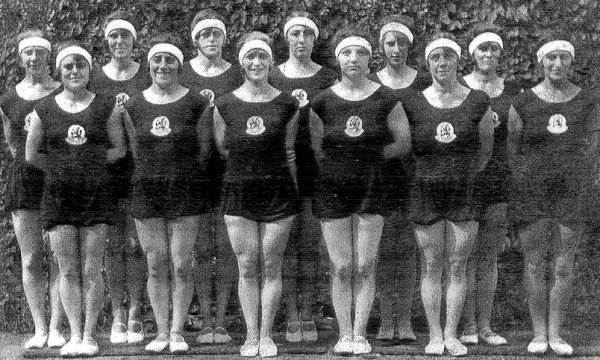
Five of the members of this team perished in the Holocaust

André Corvington (Haiti)
Fencing
Killed in action in World War I near Reims whilst serving as a medic in the French army.

SPORT DOPING – NOTHING NEW

The history of drug use, or doping, or PED use (performance-enhancing drugs), in sports is almost as old as the history of sport itself. Doping is the European term for drug use but the term is less often used in the United States. Even the name itself has a history, as it comes from the 19th century, when the term “dop” was used to describe a South African drink which was an extract of cola nuts to which was added xanthines (found in caffeine) and alcohol. The drink was intended to improve endurance and the term “doping” was derived from it.

In the Ancient Olympics, trainers gave athletes various concoctions that they felt would improve their performance. The first physician to be considered a specialist in sports medicine was Galen, who prescribed as follows, “The rear hooves of an Abyssinian ass, ground up, boiled in oil, and flavored with rose hips and rose petals, was the prescription favored to improve performance.”

In the late 1800s, trainers often gave European cyclists strychnine mixed with caffeine and alcohol. Most of the cyclists simply considered them a necessity. A similar potion, strychnine with brandy and egg white, was given to American marathoner, Thomas Hicks, when he was near collapse at the end of the 1904 Olympic marathon in St. Louis, which he went on to win.

Early documentation of sport doping focuses on cycling. The first punishment for doping in cycling goes back to the 19th century, when trainer Choppy Warburton was banned from the sport for suspicions of drugging his riders. Warburton coached Arthur Linton, who won Bordeaux-Paris in 1896, but was suspected of being doped by Warburton during that race.

All of these techniques were used to improve performance and little concern was given to them. It is safe to assume that over the next few decades drug use only increased, but it rarely made the news and there were few problems with its use. But eyebrows were raised at the 1952 Olympic Winter Games when syringes and empty drug vials were found in the speed skater’s locker rooms (speed skaters often train by cycling in the warmer months). Similar detritus was found in the cyclist’s locker rooms at the 1956 Melbourne Olympics.

It was known that the professional cyclists used drugs freely, mainly stimulants such as amphetamines. In 1924 Henri Pélissier and his brother, Charles, admitted to various doping methods, describing in an interview their use of strychnine, cocaine, chloroform, aspirin, and horse ointments, although they later stated that the writer had exaggerated their claims. By the 1940s Italian campionissimo Fausto Coppi freely admitted to doping, calling it “la bomba,” and said there was no alternative if one hoped to stay competitive.

In 1955 French rider Jean Malléjac collapsed in the Tour de France near the top of Mont Ventoux, and it was attributed to doping. He had been riding wildly and sporadically and fell off his bike with one foot still in his toe clip. He later stated he had been drugged against his will and proclaimed his innocence to his death in 2000.

Roger Rivière, a star of the late 1950s, who was paralyzed after a crash in the 1960 Tour, later admitted to doping during his career, and even said his career-ending accident was possibly due to the use of painkilling drugs which had affected his reflexes and judgment. Ironically, Rivière once commented about the marathon legend of Pheidippides, “Had the soldier from Marathon had access to some kind of restorative product, he would most likely not have died.”

At the 1960 Rome Olympics, Danish cyclist Knut Enemark Jensen collapsed and died during the cycling road race. He was later found to have been given amphetamines (Ronital) and nicotinyl tartrate (a nicotine-type of stimulant). Jensen’s death, however, caused no great call to enforce rules against drug use in sports.

In 1965 Tour superstar Jacques Anquetil admitted during a television interview that he used drugs, stating that it was common at the time, and that a man could not ride Bordeaux-Paris or the grand tours while riding only on water. On 1 June 1965, performance-enhancing drugs were made illegal in France and in July 1966 the Tour authorities began testing the riders for drugs, with Raymond Poulidor the first rider to be tested on 29 July.

The most famous drug-related sports death then occurred at the 1967 Tour de France, when the great British cyclist, Tommy Simpson, collapsed and died while ascending Mont Ventoux. An autopsy revealed he had been heavily dosed with stimulants.

Sports administrators could not continue to avoid the problem. The deaths of Jensen and Simpson alerted the sporting authorities, among them the IOC and the IAAF, to the dangers inherent in drug use in sports. At the 1968 Olympic Winter Games, the IOC tested for drugs for the first time. The first athlete to be disqualified in the Olympics for drug use was Sweden’s Hans-Gunnar Liljenwall. Liljenwall was a modern pentathlete who had helped his team win a bronze medal. Prior to the shooting event he drank a few beers to help steady his nerves. This was commonplace among modern pentathletes in those days, but it cost him and his teammates a bronze medal.

The IOC did not start testing for anabolic steroids until 1972 at the Olympics. Seven athletes were disqualified for doping offenses at the 1972 München Games, with three athletes losing medals – Rick DeMont (USA) in the controversial 400 metre freestyle, after he was found to have a stimulant (ephedrine) in his Marex inhaler that he used for his asthma; Aad van den Hoek (NED), who was found to have taken coramine, a stimulant, which eliminated the Dutch team from the team time trial, after they had placed third; and Bakhaavaa Buidaa, a Mongolian judoka who lost his silver medal when he became the first Olympian to test positive for an anabolic steroid, Dianabol.

Since the advent of drug testing, the major scandals have involved the use of anabolic steroids, blood doping, and erythropoietin (EPO). None of these just came about in the 1980s or 1990s.

Anabolic steroids had been invented in the early 1950s by the American physician, John Ziegler, who developed them to help patients with serious illnesses, including soldiers, although concurrent development by Soviet and German doctors was later revealed. Many of these patients were unable to maintain their body weight, and they essentially wasted away. The anabolic steroids were capable of keeping the patients in what is known as “positive nitrogen balance.” In that state, protein is being added, rather than taken away, from the body’s muscles. It was not long before athletes discovered their usefulness, with weightlifters and weight throwers in track & field known to have started using them in the early 1960s.

Blood doping, also termed blood boosting, blood packing, and induced erythrocythemia, involves the infusion of red blood cells to increase a person’s aerobic capacity. Rumors of blood doping first became rampant when the great Finnish distance runner, Lasse Virén, won both the 5,000 and 10,000 at the 1972 München and 1976 Montréal Olympics. Between Olympics, Virén’s performances were relatively poor – he never won any other major event. While Virén claimed he was simply a master at peaking, his rivals whispered that he was being helped by blood doping. The rumors were never substantiated.

It goes much farther back than that, however, as blood doping was first investigated in 1947 by the American physiologist Pace. He infused 2,000 cc. of whole blood into subjects and noted increases in endurance capacity of as great as 35%. Multiple other studies have also shown increases in aerobic and endurance capacity, although no study used such a massive quantity as Pace’s study. (The normal adult male has a volume of blood of about 6 liters, so Pace was injecting 1/3rd of the patient’s blood volume.)

Most studies now confirm that blood doping increases both aerobic and endurance capacity, if properly administered, but blood doping was originally not considered terribly helpful to athletes, because it was thought adding extra red blood cells to the body increased the viscosity of the blood to a point that the heart could not generate enough output to increase aerobic capacity. This has been shown not to be true in the quantities of normal blood doping.

The first known documented blood doping scandal concerned the 1984 United States Olympic cycling team that admitted to blood doping prior to the Los Angeles Olympics, which was a systematic scheme also involving their coaches. Coincidentally the American cyclists did very well, winning multiple medals and titles, albeit in the absence of the Eastern European riders. Later, at the 2002 Olympic Winter Games, after the athletes had left Salt Lake City, discarded blood bags were found at the residence of the Austrian skiers and two Austrian cross-country skiers were disqualified, as well as the team doctor.

Blood doping was somewhat supplanted by the use of erythropoietin (EPO) and its analogues. Erythropoietin is a natural hormone synthesized by the kidneys and which stimulates red blood cell formation. Erythropoietin was first synthesized as a drug in the late 1980s, after the development of recombinant bacterial production, primarily as a method of treating patients with anemia. It has been especially helpful in treating patients with renal failure and on dialysis as a result. Since the kidney produces erythropoietin, kidney failure invariably causes a deficiency of the hormone, and virtually all of these patients are anemic. It is also used in cancer patients receiving chemotherapy, which often causes the body to stop producing red blood cells naturally.

Because it will naturally boost an athlete’s red blood cell mass without the risks of either autologous or heterologous blood doping, which can transmit viral diseases, or cause transfusion reactions, athletes have often used EPO to increase their aerobic capacity. This may also create long-term problems for the athlete as use of the drug may interfere with the body’s natural production of erythropoietin. Early studies also showed that supplements of erythropoietin may increase the risks of blood clots, diabetes and hypertension (high blood pressure).

In the late 1980s and early 1990s the European cycling press investigated a series of startling deaths. At least 10 and perhaps as many as 20 professional cyclists died very suddenly. Most of these athletes were from the Netherlands or Belgium, and most were young, and in extremely good condition as a result of the demands of their sport. While never proven, the rumor was that many of these athletes died as a result of using EPO. EPO increases the amount of red blood cells in the body, but extremely fit aerobic athletes, such as professional cyclists, already have a very high percentage of red blood cells, which is measured by checking a lab value termed the hematocrit. Normal hematocrit values for adult males are in the 38-43 range, while women have a slightly lower value.

Aerobic athletes usually have very high hematocrits naturally, as they have developed their aerobic capacity by training. Their hematocrits are often in the 45-50 range. But by taking EPO, these athletes can artificially raise their hematocrit even higher, often above 50. At hematocrit levels much above 50, the blood becomes very viscous, and may sludge. It is unable to circulate easily and can lead to strokes or heart attacks. This was considered to be the etiology of many of the deaths of the professional cyclists.

And it did not stop with anabolic steroids, blood doping or EPO. After them came designer steroids, the use of pure testosterone, and testosterone/epi-testosterone combinations to avoid detection, human growth hormone or somatotropin (hGH), and on virtually ad nauseum.

And this led to …

  • the state-supported GDR doping system of the 1970s-80s, later revealed by released Stasi documents;
  • the 1983 Pan American Games in Caracas, Venezuela when tight drug testing protocols caught 15 weightlifters;
  • the Chinese system of the late 1980s in which their female distance runners set world records still never approached;
  • Ben Johnson at Seoul in 1988;
  • Marion Jones at Sydney in 2000, though not formally admitted for several years;
  • the Festina Scandal of 1998;
  • Lance Armstrong from 1999-2005 at the Tour de France;
  • the BALCO Scandal in American professional sports around 2000-02;
  • Operación Puerto in professional cycling circa 2006;
  • the Floyd Landis fiasco at the 2006 Tour de France and thereafter;
  • the admissions by Tyler Hamilton, and later Armstrong, about their drug use in cycling,
  • the Russian scandal most fully revealed on Monday, 9 November, by the release of the Pound Report, … and so it goes

The athletes continue to use performance-enhancing drugs, and the scientists, and now governments and legal agencies, continue to pursue them. Plus ça change, plus c’est la même chose.